
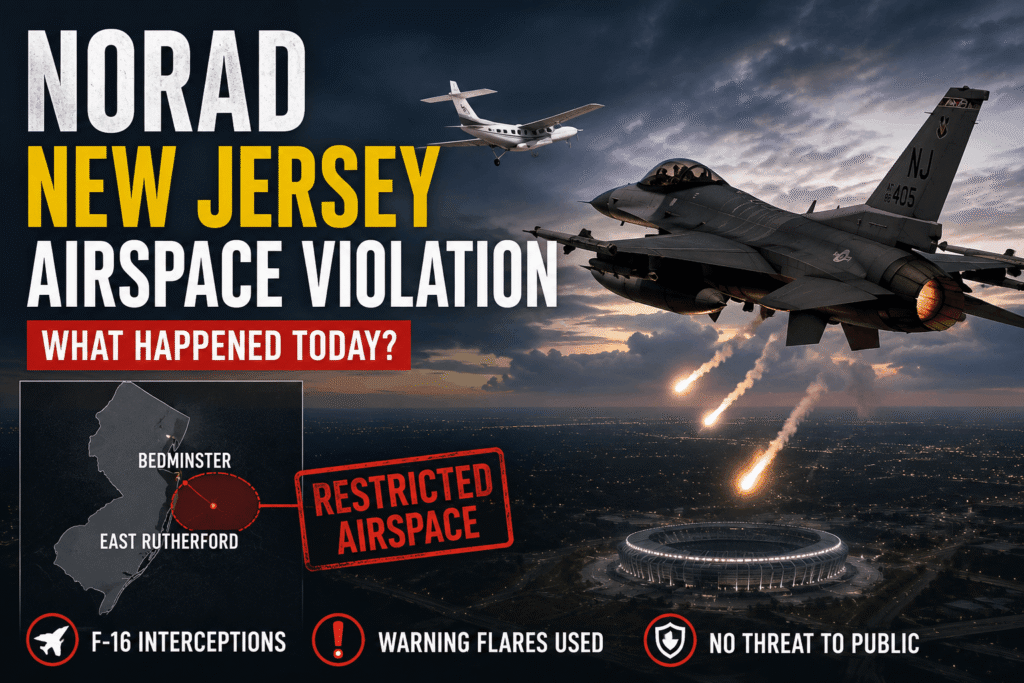
If you heard about fighter jets flying over New Jersey today, you probably wondered whether something serious had happened.
The NORAD New Jersey Airspace Violation quickly became one of the biggest trending stories after military aircraft were scrambled to intercept several civilian planes that entered restricted airspace over parts of New Jersey. Videos shared online showing bright flares in the sky only added to the confusion, leaving many people asking what was really going on.
The good news is that officials have not reported any threat to the public. According to NORAD’s official statement, the fighter jets were responding to aircraft that entered temporary flight restrictions over Bedminster and East Rutherford. The intercepted planes were safely escorted away after pilots followed instructions.
What Happened?
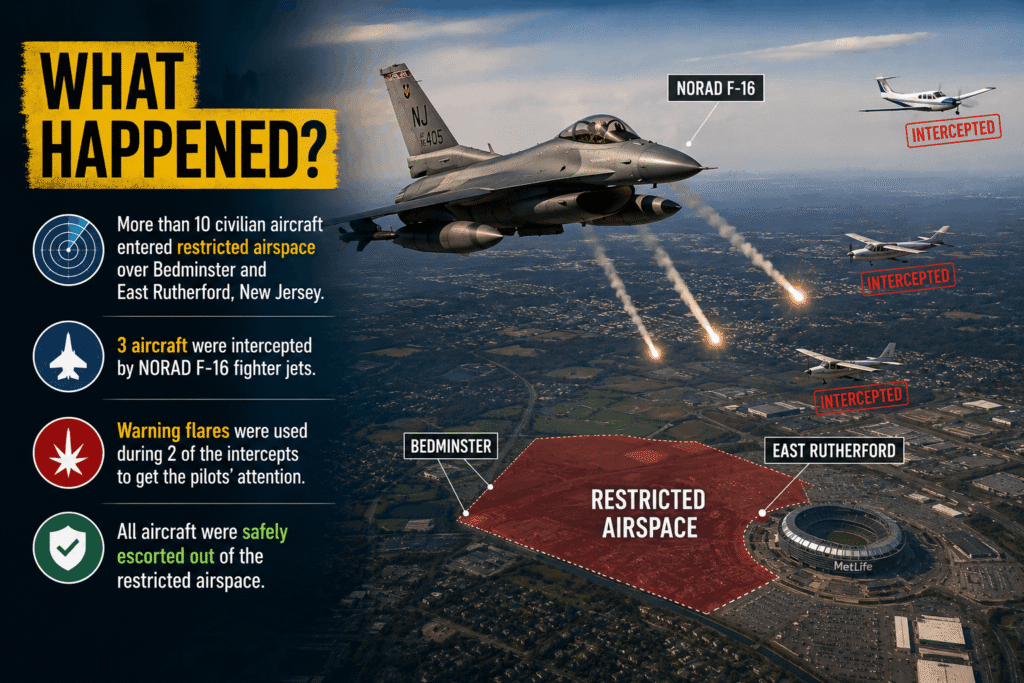
NORAD said that more than 10 general aviation aircraft entered restricted airspace over Bedminster and East Rutherford, New Jersey, on Sunday.
Not every aircraft required military action. However, three civilian aircraft were intercepted by NORAD F-16 fighter jets after entering the protected airspace without authorization.
During two of those intercepts, the F-16s released warning flares. These flares are a standard visual signal used to get a pilot’s attention if radio communication is unsuccessful or additional warning is needed.
NORAD confirmed that the flares burn out quickly and are designed so they do not pose a danger to people on the ground. You can read the military’s complete explanation in NORAD’s official news release.
According to the military, every intercepted aircraft was safely escorted out of the restricted area after complying with instructions.
Why Did NORAD Send F-16s?
Many people associate fighter jets with military conflicts, but intercept missions like this are a routine part of protecting U.S. airspace.
The F-16 intercept New Jersey mission was carried out because aircraft entered an area where flying was temporarily restricted.
When an aircraft enters protected airspace without authorization, NORAD works to identify the aircraft, communicate with the pilot, and make sure there is no security threat. If necessary, fighter jets are launched to visually identify the aircraft and guide it away from the restricted area.
In Sunday’s incident, the aircraft involved were privately operated general aviation planes rather than commercial passenger flights.
Why Was The Airspace Restricted?
Temporary Flight Restrictions, also known as TFRs, were active over parts of Bedminster and East Rutherford.
The restrictions coincided with heightened security during the FIFA World Cup Final at MetLife Stadium in East Rutherford. Large public events often receive temporary flight restrictions to help protect the venue and allow security agencies to monitor nearby air traffic more effectively.
Pilots are expected to check for active TFRs before every flight. Flying into one without authorization can result in military interception and possible enforcement action by the Federal Aviation Administration.
If you’re unfamiliar with these rules, the FAA Temporary Flight Restrictions page explains how TFRs work and why they are issued. You can also review NORAD’s aircraft interception guidance for pilots to understand what happens when a civilian aircraft is intercepted.
Why Were Warning Flares Used?
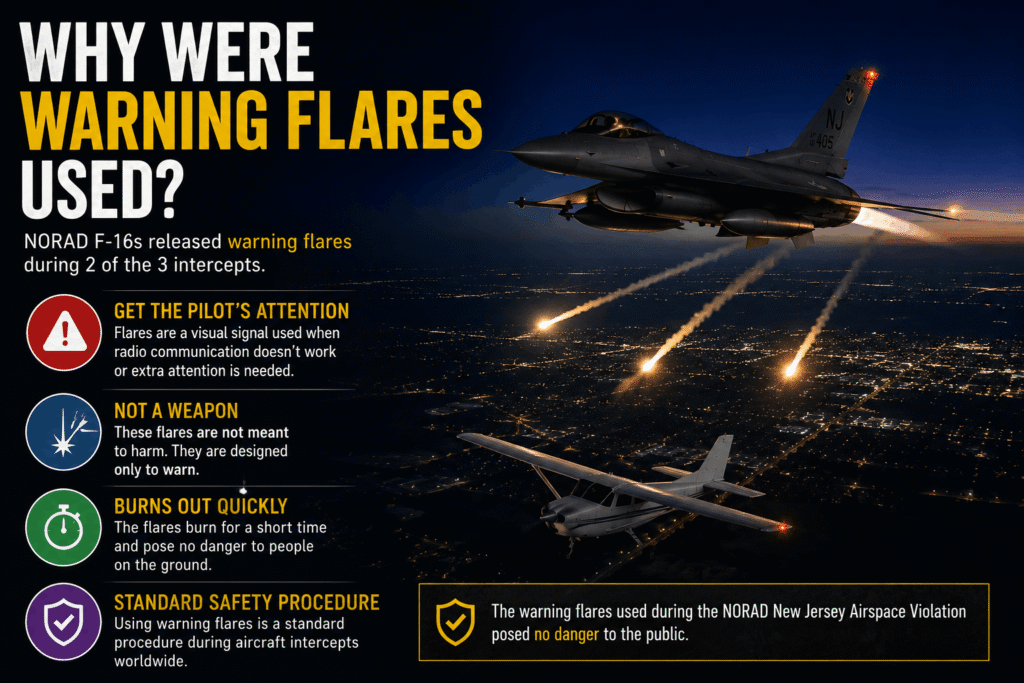
One of the biggest talking points online was the sight of bright flares falling from the sky.
While they may look dramatic, these flares are not weapons.
NORAD explained that warning flares are used as a highly visible signal to attract a pilot’s attention during an interception. They burn out quickly and are designed to avoid creating a hazard for people on the ground.
The military said warning flares were used during two of the three interceptions on Sunday. The details were confirmed in NORAD’s official incident report.
Were Any Enforcement Actions Announced?
At the time of writing, officials have not announced any arrests or criminal charges connected to the airspace violations.
NORAD’s statement focused on the successful interception of the aircraft and confirmed that every plane left the restricted area safely after following instructions.
Any enforcement action, if necessary, would typically be handled by the Federal Aviation Administration after reviewing the incident.
Is There Any Danger To The Public?
Based on the information released so far, there is no indication of an ongoing public safety threat.
NORAD said the intercepted aircraft were safely escorted away from the restricted airspace, and the warning flares used during the operation posed no danger to people on the ground.
Although seeing fighter jets over New Jersey can be alarming, officials say these intercept missions are designed to prevent potential security risks before they become more serious.
What Happens If A Pilot Enters Restricted Airspace?
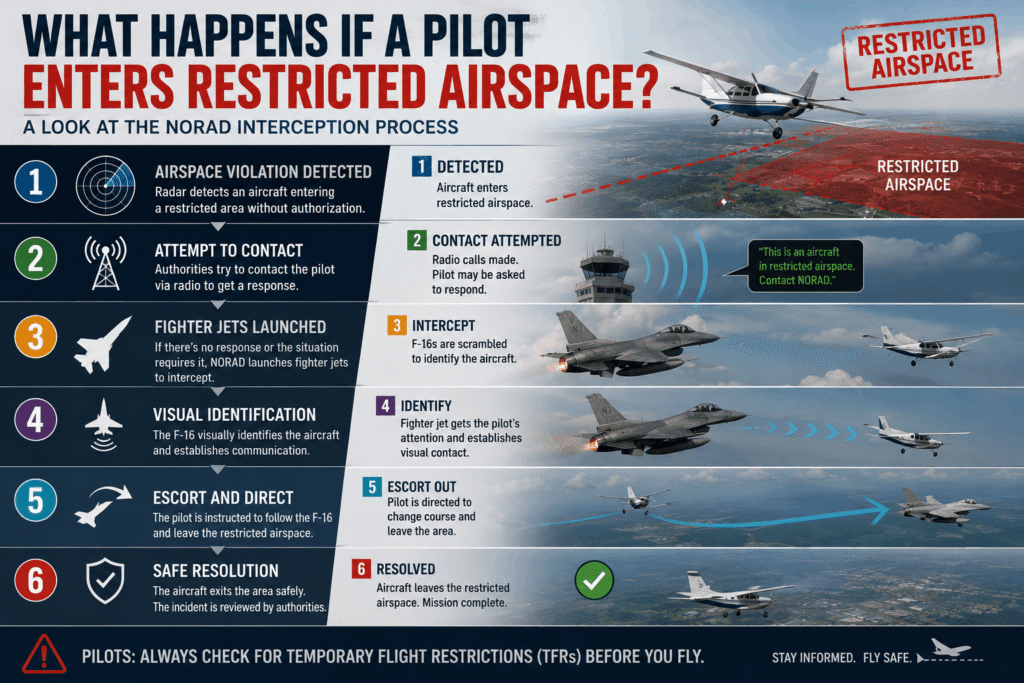
Pilots are responsible for checking whether temporary flight restrictions are active before taking off.
If an aircraft enters restricted airspace without authorization, authorities first attempt to contact the pilot by radio.
If communication is unsuccessful or additional action is needed, NORAD may launch fighter aircraft to visually identify the plane and direct it out of the restricted area. Warning flares may also be used to make sure the pilot notices the military aircraft nearby.
NORAD advises intercepted pilots to tune their radios to emergency frequencies and carefully follow the fighter aircraft’s instructions. The complete procedures are available in NORAD’s official intercept guidance.
Why This Story Is Getting So Much Attention
There are several reasons this incident quickly became national news.
First, it involved military fighter jets operating over a heavily populated area, something that naturally attracts attention.
Second, videos of the warning flares spread rapidly across social media, leading many people to wonder whether there was a security emergency.
Finally, the interceptions happened while thousands of people were gathered in East Rutherford for one of the world’s biggest sporting events. With security already high, any unusual activity in the skies was always likely to generate headlines.
Final Thoughts
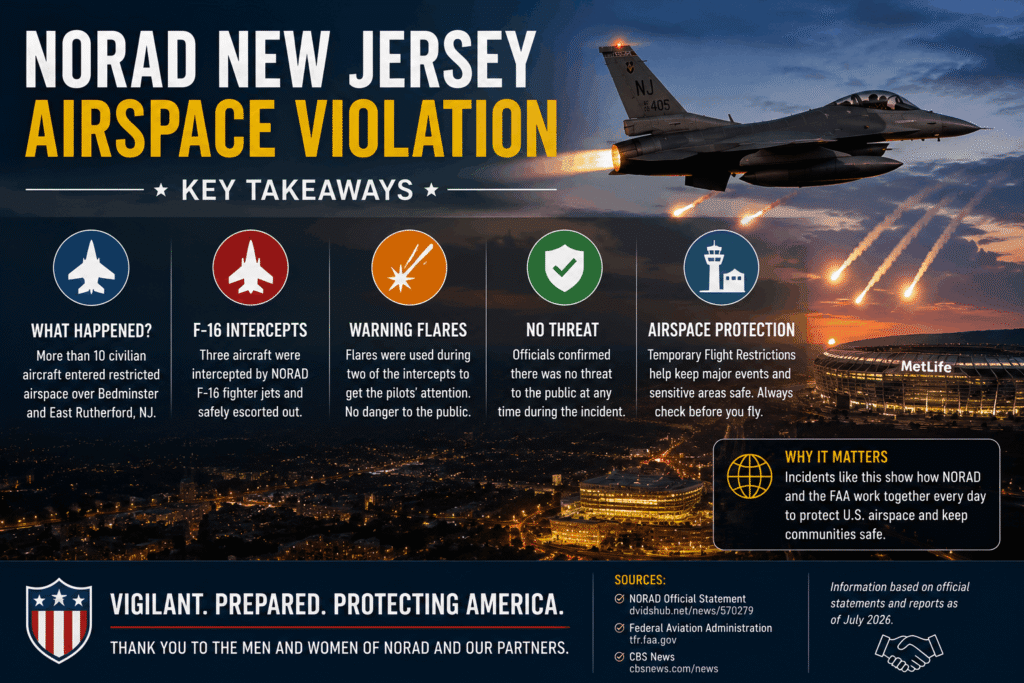
The NORAD New Jersey Airspace Violation was a reminder of how seriously U.S. authorities protect restricted airspace during major events.
According to NORAD, more than 10 civilian aircraft entered temporary flight restrictions over Bedminster and East Rutherford. Three of those aircraft were intercepted by F-16 fighter jets, and warning flares were used during two interceptions to alert the pilots. Every intercepted aircraft was safely escorted away, and officials said the flares posed no danger to people on the ground.
While the sight of military aircraft and warning flares caused concern for many people, the operation followed standard security procedures and ended without any reported injuries or public safety incidents.
If you’d like to learn more about temporary flight restrictions or aircraft interception procedures, you can visit the FAA’s Temporary Flight Restrictions page and read NORAD’s official statement about the incident.
FAQs
What is the NORAD New Jersey Airspace Violation?
The NORAD New Jersey Airspace Violation refers to multiple civilian aircraft entering restricted airspace over Bedminster and East Rutherford, prompting NORAD to launch F-16 fighter jets to intercept three aircraft.
Why did NORAD send fighter jets over New Jersey?
NORAD launched F-16 fighter jets after several aircraft entered temporary flight restriction zones without authorization. The mission was carried out to identify the aircraft and ensure there was no security threat.
Were the warning flares dangerous?
No. NORAD said the warning flares were used only to attract the pilots’ attention during the interceptions. They burned out quickly and posed no danger to people on the ground.
Why was the airspace over Bedminster restricted?
Temporary Flight Restrictions were in place over Bedminster and East Rutherford due to heightened security during major events and other protected activities. Pilots were required to avoid entering the restricted airspace without authorization.
Were there any arrests after the incident?
As of publication, officials have not announced any arrests or criminal charges related to the airspace violations. Any enforcement action would typically be handled by the Federal Aviation Administration.