
The Federal Voter ID Legislation Debate took another turn after the Senate failed to advance a Republican-backed voter ID proposal. Here’s what the vote means and what comes next.
The Federal Voter ID Legislation Debate took another turn on August 8, when the U.S. Senate failed to move forward with a Republican-backed voter ID proposal. The setback came after weeks of pressure from President Donald Trump and Republican leaders to pass stricter federal voting rules before the 2026 midterm elections.
But there is an important detail that can easily get lost in the headlines. The Senate did not pass or reject the entire SAVE America Act in a final vote. Instead, lawmakers failed to advance a narrower voter ID measure while the broader legislation remained unresolved.
That leaves the big question: What exactly happened in the Senate, and what does it mean for voters?
What Happened in the Senate?
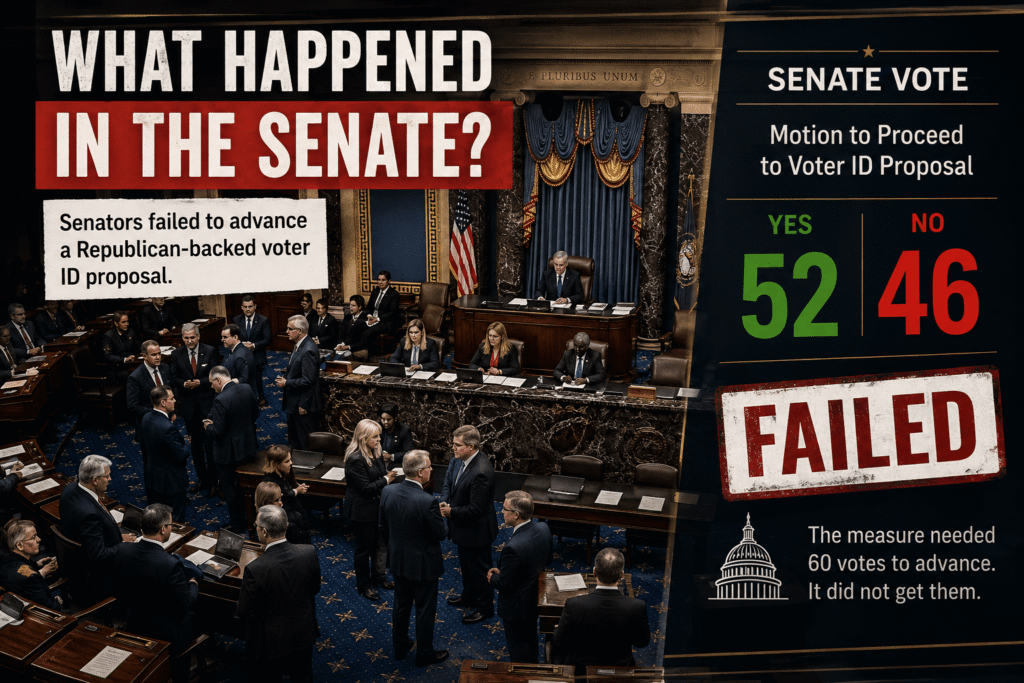
The Senate spent hours working through a busy weekend session before lawmakers left Washington for the August recess.
Republicans wanted to advance stricter voting requirements, including photo identification. However, the narrower voter ID proposal failed to get enough support to move forward.
The Senate’s procedural rules generally require 60 votes to overcome a filibuster and advance legislation. Republicans do not have enough seats to reach that number on their own, meaning they needed support from Democrats.
That support did not come.
The result was a major setback for Republicans, who had made election legislation one of their priorities. The Senate’s official records provide the formal record of votes and legislative action.
The bigger SAVE America Act also remained unfinished as senators headed home. According to the Associated Press’s report, senators left Washington without passing President Trump’s priority voting legislation.
What Is the SAVE America Act?
The SAVE America Act stands for the Safeguard American Voter Eligibility Act.
At its core, the legislation is designed to change how people register to vote in federal elections. One of its major provisions would require documentary proof of U.S. citizenship when someone registers to vote.
The proposed rules include several types of documents that could be used to prove citizenship. The legislation also contains provisions related to voter identification and voter registration records.
The Congressional Record lays out the legislation’s proof-of-citizenship requirements.
Republicans say the proposal would strengthen election security and help make sure that only eligible U.S. citizens register and vote in federal elections.
Democrats strongly oppose the legislation. They argue that stricter documentation requirements could make it harder for some eligible Americans to register or vote.
That disagreement has turned the SAVE America Act into a major political fight in Congress.
Why Did the Senate Vote Fail?
The biggest problem was not simply the popularity of voter ID. It was the number of votes needed in the Senate.
Republicans control the Senate, but their majority is not large enough to reach the 60 votes generally needed to overcome a filibuster.
Democrats opposed the Republican proposal, leaving GOP leaders without enough support to move it forward.
The result showed the difficult math Republicans face when trying to pass major election legislation.
It also showed why the broader SAVE America Act has become such a difficult issue. Even though Republicans have continued to push for the bill, they have not been able to secure enough Senate support to finish the process.
President Trump had repeatedly pressured Republicans to act on the legislation. The August recess deadline added even more pressure.
But the Senate ultimately left Washington without delivering the result Republicans wanted.
What Would a Federal Voter ID Law Change?
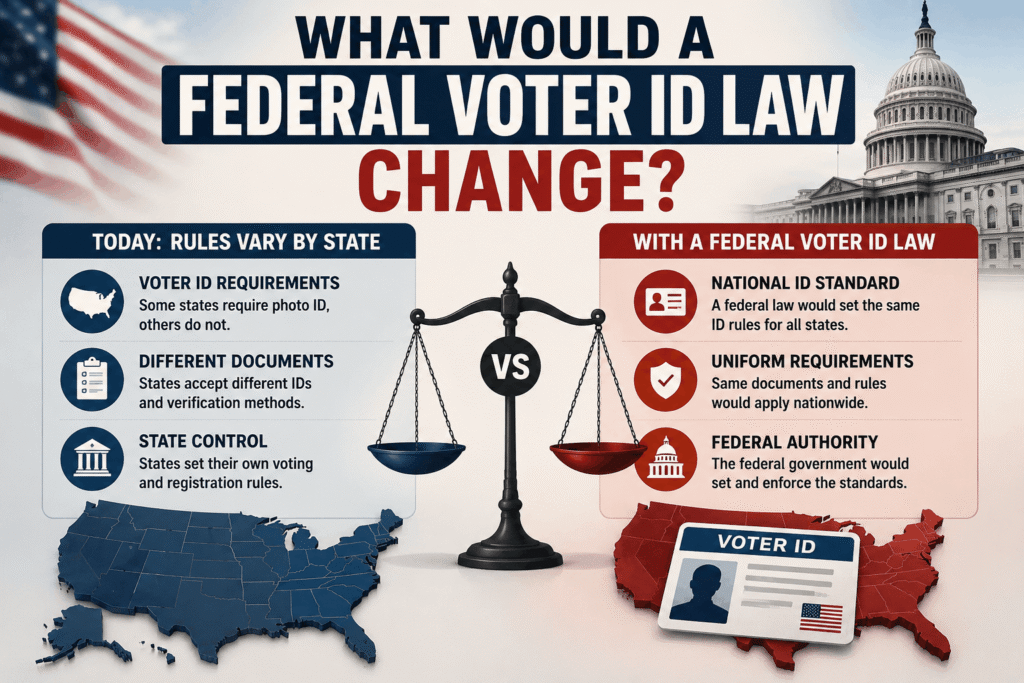
A federal voter ID law could create a national standard for identification in federal elections.
Today, voter ID requirements vary from state to state. Some states require voters to show photo identification. Others use different methods to confirm a voter’s identity.
A federal law could make certain identification requirements apply across the country for federal elections.
However, that has not happened because of the latest Senate action.
There is currently no new nationwide voter ID requirement created by this vote.
That distinction is important because someone reading social media posts about the Senate debate could easily think a new federal rule has already taken effect.
It has not.
Any future change would depend on legislation actually passing Congress and becoming law.
Why Are Democrats Opposing the Bill?
Democrats argue that the proposed requirements could create problems for eligible voters.
Their concern is mainly about documentation.
A voter may be a U.S. citizen but not have easy access to a passport, birth certificate or another document that meets a federal requirement. Problems can also happen when names or other personal details do not match across documents.
Democrats say those situations could create extra barriers for people who are legally allowed to vote.
They also argue that states and election officials already have systems for checking voter registration information.
Their position is that election security should be improved without creating unnecessary obstacles for eligible voters.
The Democratic argument is therefore less about whether identification exists and more about how strict the federal requirements should be.
Why Do Republicans Support It?
Republicans argue that federal elections need stronger safeguards.
Their position is that people registering to vote should be able to prove that they are U.S. citizens. They also support photo identification requirements for voters.
Republicans say these measures could increase confidence in elections and create clearer national standards.
Supporters have repeatedly described voter ID as a basic election security measure. The Congressional Record includes arguments made by Republican senators in support of the legislation.
But the debate is not only about whether voters should show identification.
It is also about which documents should be accepted, how people without those documents would be handled and how much authority the federal government should have over election rules traditionally administered by states.
That is why the issue has become much bigger than a simple ID requirement.
What Happens Next?
The August recess does not mean the Federal Voter ID Legislation Debate is finished.
Republicans are expected to continue looking for a way to advance their voting priorities when Congress returns.
The Associated Press reported that Republican lawmakers could revisit the issue in September and consider tying parts of the voting legislation to a larger budget package.
That could create another major fight in Congress.
The timing is also important. The 2026 midterm elections are approaching, so any major change to federal voting rules would receive heavy political attention.
The issue also connects to a broader argument about how much power Washington should have over states. A similar federal-state dispute can be seen in the California vs. federal troops legal battle, where questions about federal authority have also become a major issue.
For voters, though, the immediate situation is simple.
No new nationwide voter ID rule took effect because of the August Senate action.
The Bottom Line
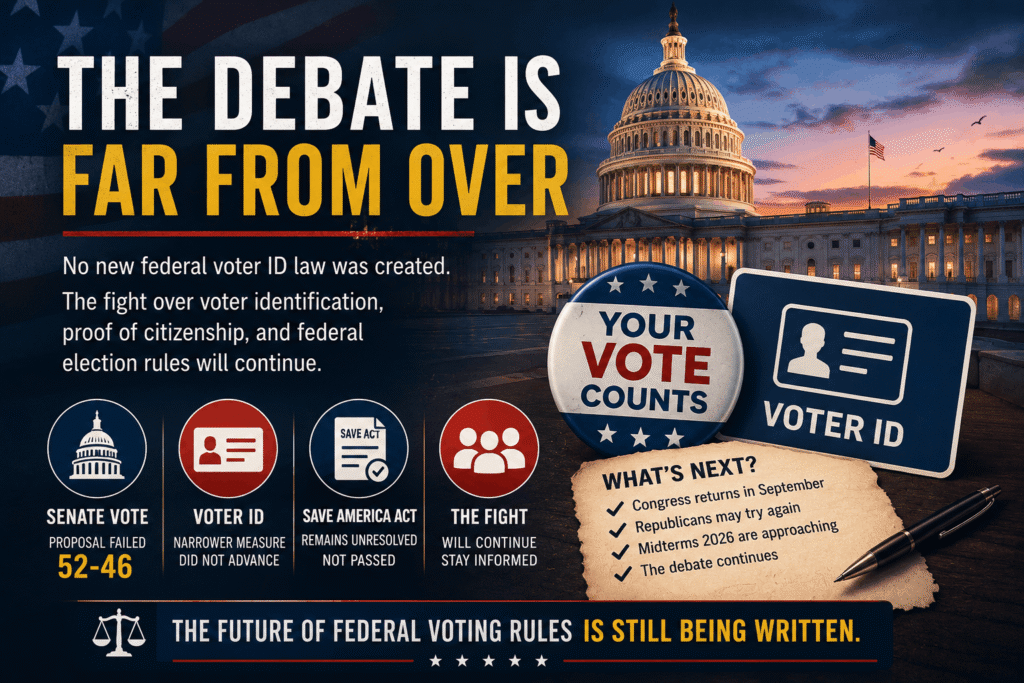
The latest Senate action was a setback for Republicans, but it did not end the fight over federal voting rules.
Republicans failed to advance the narrower voter ID proposal, while the broader SAVE America Act remained unresolved as senators left Washington for the August recess. The Associated Press reported that lawmakers would likely return to the issue in September.
For now, voters do not need to change anything because of this Senate vote.
There is no new federal voter ID law taking effect as a result of the August 8 action.
The real battle will come when Congress returns and lawmakers decide whether to try again.
With the 2026 midterm elections getting closer, the debate over voter identification, proof of citizenship and federal control of election rules is likely to remain one of the most closely watched political fights in Washington.
FAQs
What is the Federal Voter ID Legislation Debate?
The Federal Voter ID Legislation Debate is the ongoing political fight over whether the federal government should create stricter identification and citizenship documentation requirements for voting in federal elections.
What happened to the voter ID bill in the Senate?
The Senate failed to advance a narrower Republican-backed voter ID proposal during its August 8 session. The measure did not receive the 60 votes needed to move forward.
Did the Senate pass the SAVE America Act?
No. The broader SAVE America Act was not passed by the Senate before lawmakers left Washington for the August recess.
What is the SAVE America Act?
The SAVE America Act is a Republican-backed proposal that would require documentary proof of U.S. citizenship when registering to vote in federal elections. It also includes additional election-related requirements.
Is there a new federal voter ID law?
No. The latest Senate action did not create a new nationwide federal voter ID requirement.
Why do Republicans support federal voter ID legislation?
Republicans argue that voter identification and proof-of-citizenship requirements could strengthen election security and increase confidence in federal elections.