
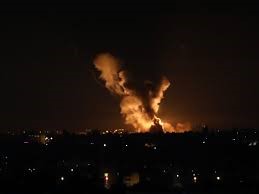
The question right now is not whether tensions are rising in the Middle East. That part is obvious.
The real question is whether the conflict between Israel and Iran is transforming into something broader — something that looks a lot like an Iran multi-front war.
When fighting stretches across borders, involves allied armed groups, and forces military repositioning in multiple directions, it stops being a contained confrontation. It starts becoming a regional equation.
And that is where we are heading.
The Escalation Is No Longer Contained
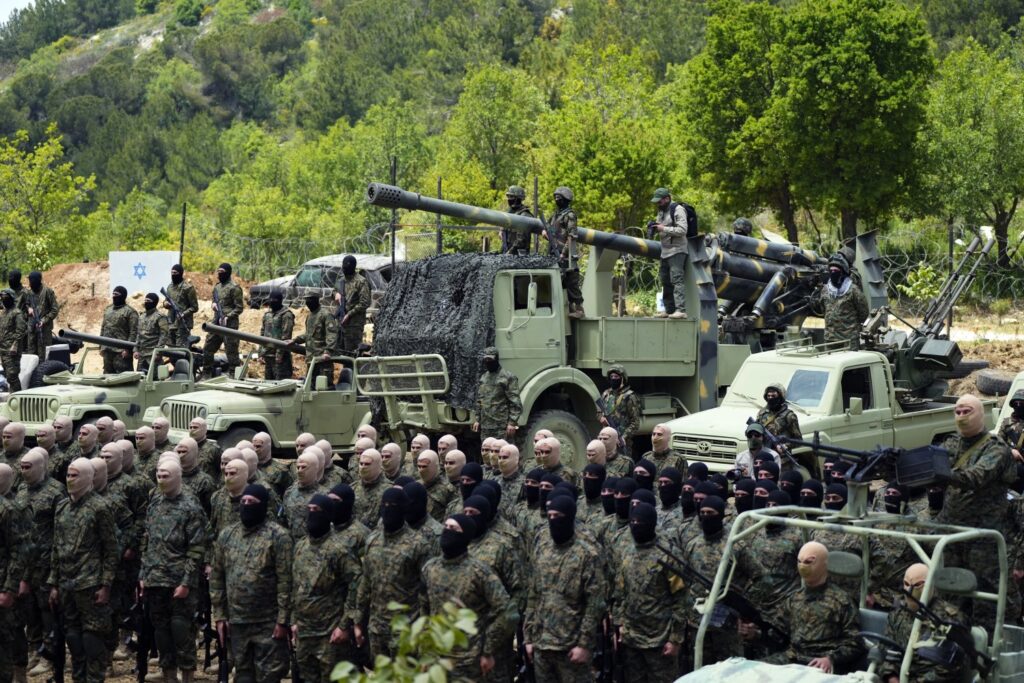
Recent exchanges confirm that this is not just Israel striking Iranian-linked targets and waiting for retaliation.
According to reporting from Reuters, cross-border fire between Israel and Hezbollah has intensified along the Lebanon frontier. Israeli air operations have targeted Hezbollah-linked positions after rockets were launched into northern Israel.
At the same time, broader confrontation between Israel and Iran has escalated, raising concerns that what began as targeted operations is widening. Associated Press notes that regional tensions are increasing amid military activity linked to both Iranian and Israeli forces.
This is no longer one axis of confrontation. It is layered pressure.
What Does an Iran Multi-Front War Actually Mean?
A multi-front war does not require a formal declaration.
It requires simultaneous operational pressure across separate theaters.
Right now, Israel is managing:
- Direct confrontation linked to Iran
- Northern border exchanges with Hezbollah in Lebanon
- Rising alert levels across the region
Hezbollah’s geographic position matters. Its missile capabilities alone force Israel to divide defensive resources.
When one actor must defend multiple borders at once, escalation risk rises sharply.
From Tehran’s perspective, pressure applied through aligned groups expands leverage without necessarily committing full conventional forces. That is strategic design, not coincidence.
Multi-front dynamics are not defined by headlines. They are defined by military positioning.
Hezbollah’s Role in Expanding the Conflict
Hezbollah’s involvement changes the equation.
As discussed in our earlier analysis of the Hezbollah role in Iran war, the group operates as both a political actor in Lebanon and a heavily armed militia aligned with Iranian interests.
Recent developments show Israel deploying additional forces near its northern border following exchanges with Hezbollah. Reuters specifically reports Israeli troop movements in response to cross-border fire. That type of repositioning signals that military planners are preparing for sustained pressure.
Even limited rocket exchanges can:
- Trigger deeper retaliatory air operations
- Increase civilian displacement near border regions
- Invite broader regional involvement
Hezbollah entering the active phase of this confrontation signals that Iran’s influence is not confined to one battlefield.
Why the United States Is Watching Closely
The United States is not announcing a new war declaration, but it cannot ignore the trajectory.
Here is why.
1. Alliance Calculations
Washington’s longstanding strategic support for Israel means that sustained multi-front pressure complicates U.S. diplomatic positioning.
If Israel is forced to divide military resources across northern and potentially additional fronts, U.S. defense coordination becomes more sensitive.
2. Military Presence in the Region
American forces remain stationed throughout the Middle East. Heightened regional instability increases force protection concerns.
Even if U.S. troops are not the primary targets, proximity to escalation zones matters.
3. Strategic Stability
Regional wars affect global power balance. The more actors involved, the more difficult de-escalation becomes. Washington is monitoring this carefully, particularly as allied and adversarial responses unfold.
This is not abstract geopolitics. It is live military calculus.
Is This Truly a Multi-Front War Yet?
Not formally.
There has been no declaration of regional war from Iran, Israel, or Hezbollah.
However, operational indicators are moving in that direction:
- Active exchanges across the Israel-Lebanon border
- Direct confrontation linked to Iranian interests
- Israeli force deployments adjusting to northern pressure
Multi-front conditions do not begin with announcements. They begin with sustained operational overlap.
Right now, that overlap is visible.
The Lebanon Factor
Lebanon adds complexity.
Hezbollah operates within Lebanese territory, but Lebanon’s central government does not necessarily direct Hezbollah’s military decisions.
That creates a layered sovereignty issue.
If Israeli air operations expand further into Lebanon in response to continued rocket fire, the consequences extend beyond military targets. Civilian displacement, infrastructure damage, and diplomatic pressure could increase rapidly.
Historically, exchanges between Israel and Hezbollah have escalated quickly once sustained operations begin.
That pattern is what analysts are watching closely.
Could Other Actors Enter the Conflict?
Regional conflicts rarely remain binary.
If escalation continues, analysts will monitor:
- Whether Hezbollah increases the scale or frequency of attacks
- Whether Iran deepens direct engagement beyond signaling
- Whether additional aligned groups activate
- Whether neighboring states increase defensive or offensive posture
The more actors involved, the harder conflict containment becomes.
Regional alliances are interlinked. Escalation in one border zone often produces ripple effects in others.
What Happens Next
The trajectory now depends on restraint or momentum.
If cross-border exchanges remain limited and diplomatic backchannels function effectively, escalation may stabilize.
If retaliatory cycles intensify, target lists expand, and troop deployments increase, multi-front characteristics will solidify.
Military planners on all sides are likely recalculating right now.
The next few days will determine whether this remains controlled confrontation or becomes sustained regional conflict.
The Bigger Question
The phrase Iran multi-front war may sound dramatic. But it reflects a legitimate strategic concern.
When fighting spreads across borders, involves aligned armed groups, and forces repositioning across multiple theaters, the risk level changes.
Hezbollah’s engagement signals that this conflict is no longer confined to a single axis.
For the United States and its allies, the stakes involve alliance credibility, troop safety, and long-term regional stability.
This is not declared regional war. Not yet.
But it is no longer a contained confrontation either.
And that distinction is exactly why global capitals are watching every move.
FAQs
What is an Iran multi-front war?
An Iran multi-front war refers to a situation where conflict spreads across multiple borders, involving Iran, Israel, and aligned groups such as Hezbollah operating from Lebanon.
Is Hezbollah officially at war with Israel?
Hezbollah has engaged in cross-border exchanges, but there has been no formal declaration of full-scale war. Escalation remains active but limited.
Why is Hezbollah involved in the Iran conflict?
Hezbollah is backed by Iran and often acts in alignment with Iranian strategic interests, particularly during periods of heightened confrontation with Israel.
Could the Iran conflict expand further?
If cross-border exchanges intensify or additional actors become involved, the conflict could widen into a broader regional war.
How does this affect the United States?
The U.S. supports Israel and maintains troops in the region. Escalation increases strategic risks, alliance pressure, and potential economic ripple effects.
1 thought on “Is the Iran Conflict Turning Into a Multi-Front War? What the Hezbollah Escalation Signals”