
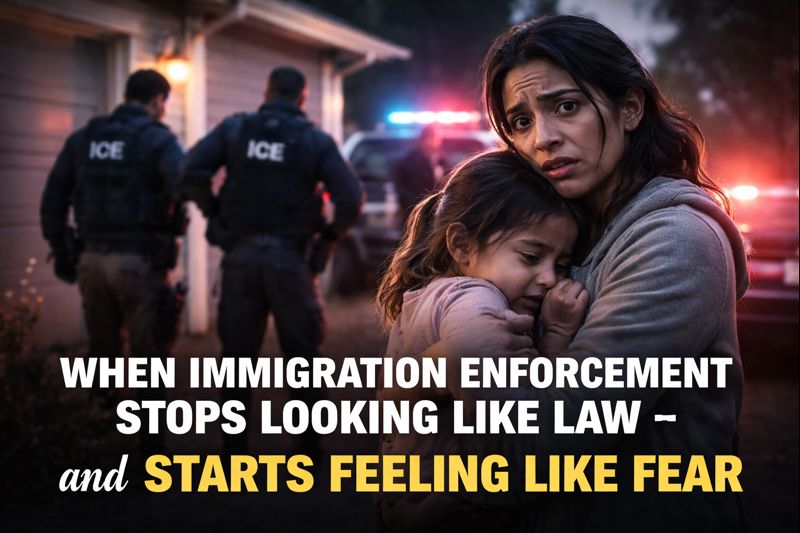
There’s a point where US immigration enforcement stops resembling law and order — and starts feeling like something else entirely. Fear. Randomness. Power without accountability.
For millions of people living in America right now, enforcement isn’t a policy debate or a cable-news argument. It’s a knock on the door at the wrong hour. It’s a job abandoned mid-shift. It’s kids coming home to a house that suddenly feels hollow.
This isn’t about paperwork. This is about people.
US Immigration Enforcement and the Cost Nobody Counts
Start here — because this is where the damage actually begins.
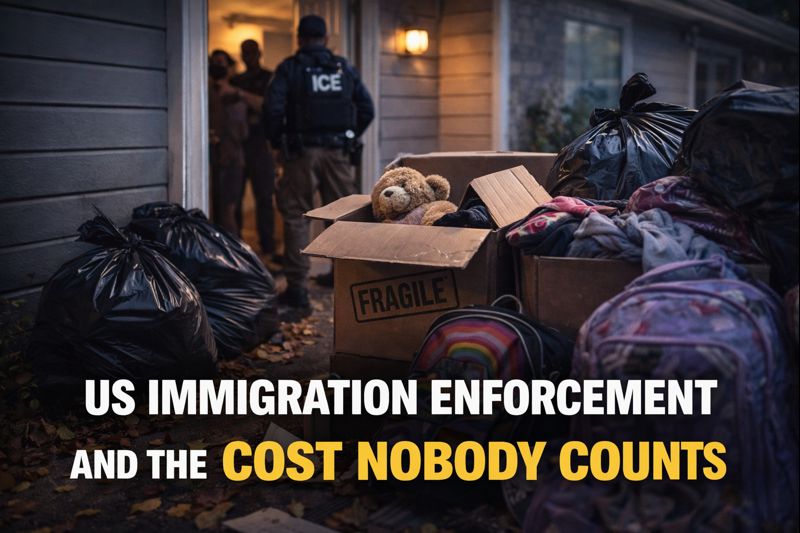
Families don’t “violate immigration rules” in the abstract. They lose leases. They lose community. They lose stability. A single enforcement action can mean rent unpaid, belongings left behind, lives packed into garbage bags.
Plenty of families who had lived in the same apartment for years — paid taxes, worked jobs no one else wanted — were forced out overnight. Not because they were dangerous. Not because they were hiding. But because the system finally noticed them.
Organizations like the ACLU have documented how immigration actions routinely result in evictions, homelessness, and family displacement, yet housing loss is never part of the “official cost” of enforcement.
Because the system doesn’t count what it breaks.
Who Was Taken Away
This is the part people try to sanitize with phrases like “detained” or “processed.”
Let’s call it what it is: people were taken away.
Parents pulled from workplaces. Spouses separated at traffic stops. People who left in the morning assuming they’d be back by dinner — and never returned.
According to data tracked by Pew Research Center, the majority of undocumented immigrants in the U.S. have lived there for over a decade. Many have U.S.-born children. Many have no criminal record.
Yet U.S. Immigration and Customs Enforcement continues to frame these removals as necessary enforcement, even when the human cost is permanent separation.
No goodbye. No closure. Just absence.
Who’s Living in Fear (Even If Nothing Happened to Them)
This is the part people outside the system never understand.
Fear spreads faster than enforcement itself.
You don’t need to be detained to be affected. You just need to know someone who was. Suddenly parents stop driving. Kids stop going on school trips. People avoid hospitals. Abuse goes unreported. Wages get stolen — because who’s going to complain?
A report by Human Rights Watch shows how aggressive enforcement creates community-wide fear, making entire neighborhoods quieter, poorer, and more isolated.
That’s not law enforcement. That’s intimidation by consequence.
Who Benefits From This Chaos
Now ask the uncomfortable question: who actually wins?
Not public safety — crime rates don’t magically drop.
Not taxpayers — enforcement costs billions every year.
Not communities — they’re destabilized and fractured.
The winners are political.
Fear is useful. Chaos is leverage. Immigration enforcement becomes a talking point, a bargaining chip, a headline generator. It allows leaders to look “tough” without solving anything.
Private detention contractors profit. Politicians posture. Media cycles spin.
Meanwhile, real people pay the price — quietly, off-camera.
This Isn’t a Broken System — It’s a Designed One
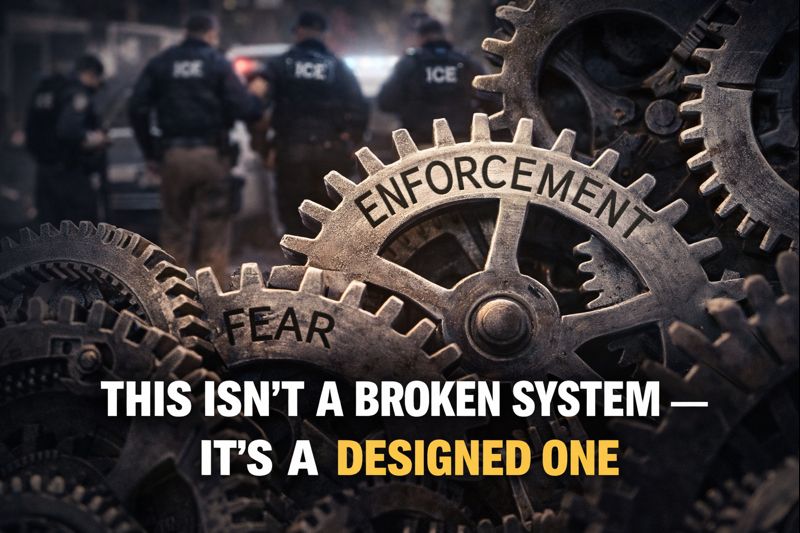
Here’s the truth nobody likes to admit: US immigration enforcement isn’t failing. It’s functioning exactly as designed.
A system built on ambiguity keeps people vulnerable.
A system that moves slowly keeps families in limbo.
A system that punishes visibility encourages silence.
Calling this a “controversy” makes it sound accidental. It isn’t.
As the Migration Policy Institute has pointed out repeatedly, enforcement strategies prioritize removals over long-term solutions — because solutions would require political courage. Fear requires none.
What This Means Right Now
If enforcement looks harsher, it’s because visibility has increased — not cruelty. The cruelty was always there. It just didn’t trend.
And that’s the most dangerous part.
When a system becomes normal, outrage fades. Stories blur together. Another family disappears. Another child learns to live with uncertainty.
Law is supposed to protect people.
When it starts controlling them through fear, it loses its legitimacy.
Final Word
This isn’t about borders versus open borders.
This isn’t about left versus right.
This is about what happens when immigration enforcement stops serving justice and starts serving power.
And if that makes you uncomfortable — good.
It should.
FAQs
What is US immigration enforcement?
US immigration enforcement refers to the policies and actions used by the federal government to identify, detain, and remove undocumented immigrants from the United States. While framed as law enforcement, its impact often extends far beyond legal boundaries into everyday family and community life.
Why is US immigration enforcement so controversial?
Because it frequently results in family separation, housing loss, and widespread fear — even among people who are not directly targeted. Civil rights groups argue that enforcement prioritizes removals over human consequences.
Who carries out US immigration enforcement?
The primary agency responsible is U.S. Immigration and Customs Enforcement, commonly known as ICE, which operates under the Department of Homeland Security.
Does US immigration enforcement mainly target criminals?
Despite public messaging, multiple studies show that many people affected by enforcement have no serious criminal record and have lived in the U.S. for years, often with U.S.-citizen family members.
How does US immigration enforcement affect families?
Families can lose income, housing, and stability overnight. Children may return home from school to find a parent missing, creating long-term emotional and economic trauma.
Why do communities fear immigration enforcement even without raids?
Fear spreads through proximity. When one person is taken, entire neighborhoods change behavior — avoiding hospitals, schools, and police — creating silence rather than safety.
Is US immigration enforcement considered effective?
That depends on the definition of “effective.” While deportation numbers fluctuate, long-term immigration challenges remain unresolved, suggesting enforcement alone does not address root causes.
Why do critics say the system is designed this way?
Because prolonged uncertainty, inconsistent enforcement, and fear-based compliance discourage resistance while avoiding comprehensive reform — a politically convenient outcome.
2 thoughts on “When Immigration Enforcement Stops Looking Like Law — and Starts Feeling Like Fear”