
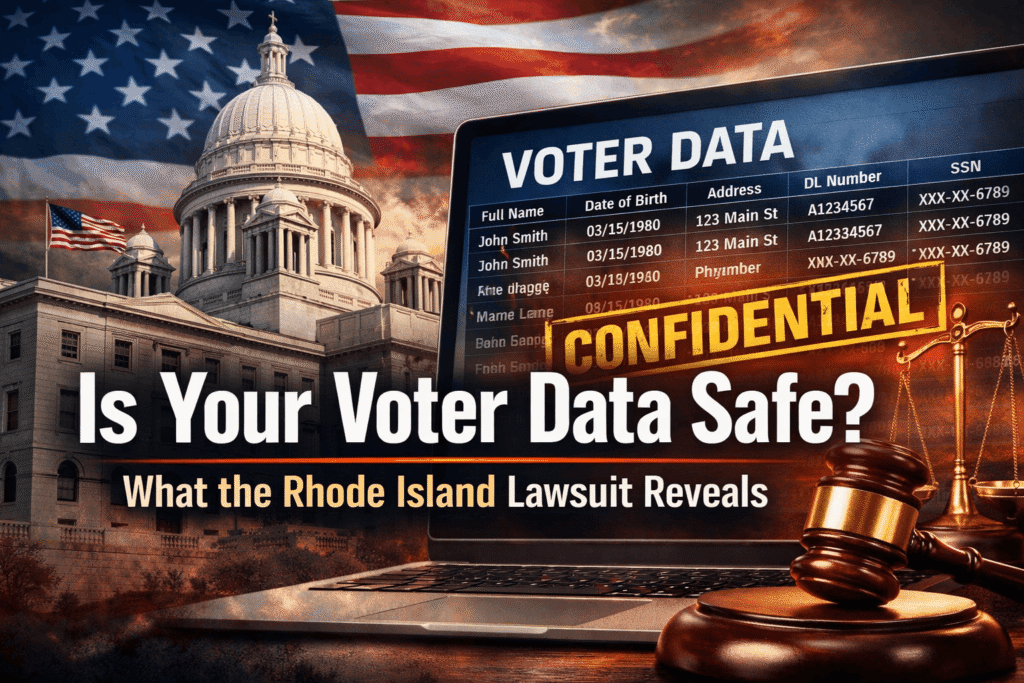
A federal judge just shut down the DOJ’s fifth attempt to seize unredacted voter records — and the reason it keeps losing tells you everything about who really controls your personal data.
If you are registered to vote in the United States, your name, home address, date of birth, driver’s license number, and a partial Social Security number are sitting inside a state voter roll database right now. You probably never thought much about who has access to that file. After what just happened in Rhode Island, you probably should.
On April 17, 2026, a federal judge dismissed a Department of Justice lawsuit that tried to force Rhode Island to hand over its unredacted voter registration data. This development, now widely referred to as the rhode island voter data lawsuit, sounds like inside-baseball legal news. It is not. This case cuts right to the heart of who controls the most sensitive information the government holds on you as a citizen — and the story is a lot bigger than one small state on the East Coast.
Why the Rhode Island Dismissal Matters Right Now
The DOJ first came knocking on Rhode Island’s door back in September 2025. The ask was not for the standard public voter list — Rhode Island’s Secretary of State Gregg Amore had already offered that. The federal government wanted the full file: every field, no redactions, no limits. Rhode Island said no.
U.S. District Judge Mary McElroy agreed with the state. In a blunt 14-page ruling, she called the DOJ’s demand a “fishing expedition” not permitted under federal election law, and noted the government had failed to present a single factual allegation suggesting Rhode Island was actually violating any voter list maintenance requirement.
Three things make this ruling especially significant:
- The “Trump Appointee” Factor. Judge McElroy was appointed by Donald Trump during his first term. Her ruling carries a clear signal of judicial independence — this is not a partisan “Blue State vs. Red Administration” fight. It is a fundamental question of statutory authority, and a judge from within the president’s own legal legacy answered it against the administration.
- The Fifth Straight Loss. According to Democracy Docket, which tracks voting rights litigation in real time, Rhode Island is now the fifth consecutive defeat for the DOJ in cases like this, following rejections in California, Oregon, Michigan, and Massachusetts.
- The Secretary of State Pushed Back Personally. Judge McElroy also denied a separate motion that would have compelled Amore to turn over the data in his personal official capacity. He called the demand a constitutional overreach. The court agreed.
What Data Was Actually Being Demanded?
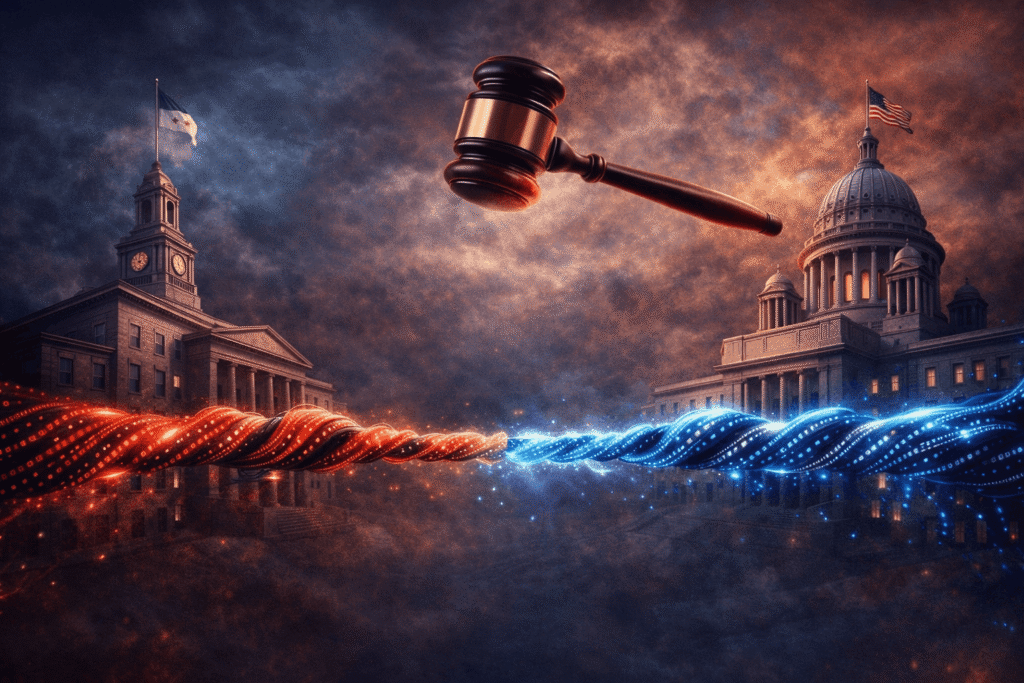
When most Americans think “voter data,” they picture the basics: name, address, party affiliation. That is roughly what you would see on a public state portal. But the DOJ was not after the lite version. The unredacted voter rolls at the center of this case include:
- Full legal names and home addresses
- Exact dates of birth
- Driver’s license numbers
- The last four digits of Social Security numbers
That combination is essentially a starter kit for identity theft. A name plus a date of birth plus a partial SSN is enough to open accounts, pass security questions, and verify identity on dozens of platforms Americans use every day — from financial apps like Credit Karma and Chime to government portals like the Social Security Administration’s own online system.
There is another dimension to this that deserves attention: centralization risk. When this kind of sensitive data is spread across 50 separate state systems, a breach in one state affects that state’s voters. If the federal government successfully pulls all of it into a single centralized hub, it creates a high-value target for hackers that simply does not exist today. A single successful intrusion could expose every registered voter in the country at once. Rhode Island’s position was straightforward — the public list is fair game, the sensitive version is not.
The Bombshell: The DHS Connection
Here is the part that should make every American, regardless of politics, sit up straight. During a March 2026 hearing, DOJ attorneys acknowledged — for the first time publicly — that they planned to share the unredacted voter data with the Department of Homeland Security. The stated purpose: to run every registered voter’s name through the DHS “SAVE” database to identify noncitizens on the rolls.
The original framing from the administration was election integrity — making sure states were complying with the National Voter Registration Act and the Help America Vote Act. That sounds reasonable on its face. But the actual use case that emerged in court was an immigration enforcement cross-check — a significant shift in purpose that alarmed election officials across party lines.
Rhode Island’s Secretary of State was direct: the state was being asked to hand over private voter information for purposes that go far beyond what any federal election statute contemplates. Civil rights groups warned about the creation of a de facto national voter database — something Congress has never authorized and the U.S. has never had. Judge McElroy found no legal authorization for the demand regardless of its stated purpose. The court drew the line.
This Isn’t Just Rhode Island: The National Picture
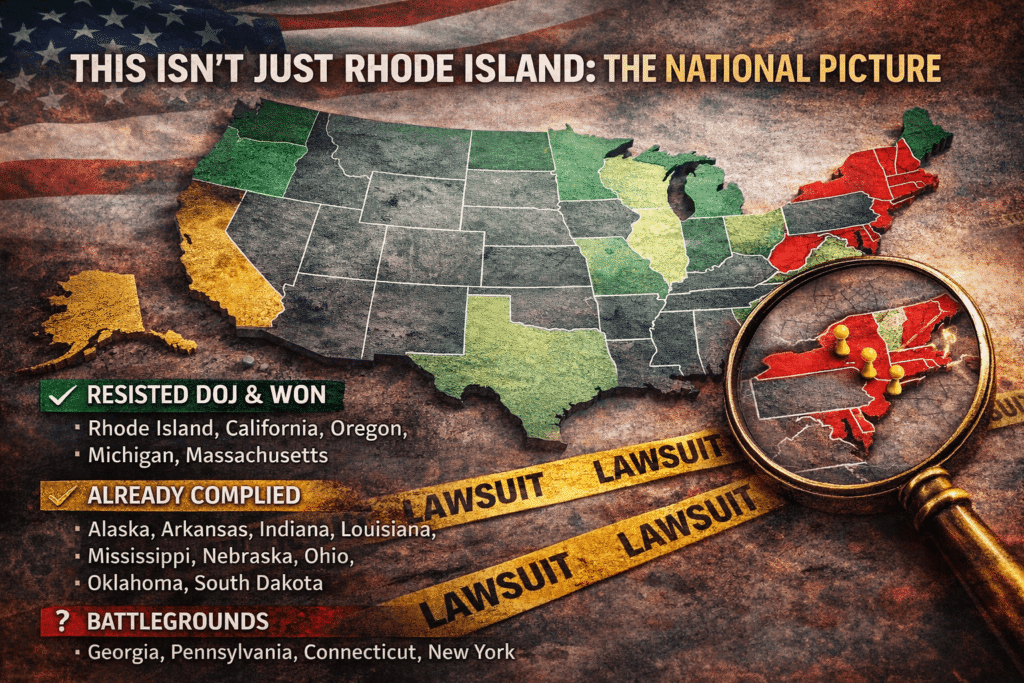
The DOJ has sued at least 30 states plus the District of Columbia over this exact issue. The country currently falls into three distinct camps:
The Resisters ✓ Won
- Rhode Island
- California
- Oregon
- Michigan
- Massachusetts
Already Complied
- Alaska
- Arkansas
- Indiana
- Louisiana
- Mississippi
- Nebraska
- Ohio
- Oklahoma
- South Dakota
Battlegrounds
- Georgia
- Pennsylvania
- Connecticut
- New York
California’s fight against the federal data grab is part of a broader pattern of state-level pushback against federal overreach — the same dynamic playing out in California’s ongoing legal battle over federal troop deployments. States are consistently finding themselves in court to defend jurisdictional boundaries that were previously taken for granted.
If you live in a compliant state, that ship has already sailed. Your unredacted personal data — name, birthdate, license number, partial SSN — is already sitting in a federal database. The Brennan Center for Justice has been tracking which states handed over data and under what conditions. If you live in a resisting state, your Secretary of State is currently spending tax dollars to keep that data behind a state-level firewall — and the fight is not over.
The Legal Question: What Federal Law Actually Says
The DOJ’s argument leans on two statutes:
The National Voter Registration Act (NVRA) requires states to maintain accurate voter rolls and allows federal inspection of certain records. The Civil Rights Act of 1960 gives the DOJ authority to inspect “any record or paper” relating to an act prerequisite to voting.
The problem — as courts have now found five times in a row — is that neither law appears to authorize what the DOJ is actually demanding. The NVRA does require states to make voter registration records available for public inspection, but it does not grant the federal government unlimited access to unredacted private data with no documented compliance concern.
“No basis — none.” That was Judge McElroy’s language describing the government’s case for why Rhode Island was failing its list-maintenance obligations. Courts in California, Oregon, and Massachusetts have echoed the same standard: show us evidence that this state is actually breaking the law before seizing its most sensitive data.
The deeper legal principle is significant. Election administration in the United States has always been a state function. The Constitution grants states broad authority over how they run their elections. Federal oversight exists within defined limits — and courts appear to be holding that line.
What Happens Next: Three Possible Outcomes
As of April 18, 2026, the DOJ is already adapting — asking courts in 13 states, including Connecticut, New York, and Pennsylvania, for permission to refile with more specific legal justifications. Here is how this likely plays out:
Scenario 1: The DOJ sharpens its argument and wins narrower access in some states.
If the administration can tie a records request to a specific, documented compliance failure in a particular state, it might survive judicial review. This would be a more limited version of what was originally sought, but it would establish a legal foothold.
Scenario 2: The litigation drags on state by state with mixed results.
This is the most likely near-term outcome. Some states comply voluntarily, some fight and win, some fight and lose. The result is a patchwork system where your voter data privacy depends entirely on your ZIP code — with no clear national standard.
Scenario 3: Courts consistently reject the demands and the legal foundation collapses.
If federal courts keep ruling against the DOJ at the current rate, it becomes increasingly difficult to argue there is any statutory pathway to broad, unredacted voter data access under current law. That pushes the issue toward Congress — or eventually the Supreme Court.
Is Your Voter Data Safe? Here’s How to Find Out
The honest answer depends entirely on where you live. If your state has already complied, your unredacted personal data is in federal databases right now. If your state fought back and won, your data remains under state control — though that protection could still be challenged. If your state is in active litigation, the outcome is still being decided.
Practical steps worth taking regardless of your state:
- Check your Secretary of State’s website to find out what voter data your state makes public, what it keeps private, and whether it has complied with any DOJ requests.
- Review your voter registration to make sure your information is current. Outdated data can create complications regardless of who accesses the file.
- Monitor your credit through free tools at AnnualCreditReport.com or apps like Credit Karma. If you are in a compliant state, consider placing a credit freeze with Experian, Equifax, and TransUnion as a precautionary layer.
- If you believe your personal information has already been misused, the federal resource IdentityTheft.gov provides a step-by-step recovery plan.
- Stay current on your state’s litigation status by following Democracy Docket, which tracks every active voting rights case in real time, and PBS NewsHour’s politics desk for ongoing national coverage.
The Bigger Picture: A Structural Test of American Democracy
What the Rhode Island voter data lawsuit reveals is not really about one state or one rejected request. It is about where the line sits between federal authority and state control over election infrastructure — and whether that line can hold under sustained pressure.
The fact that a Trump-appointed judge dismissed this case is meaningful. It signals that the legal problems with the DOJ’s approach are not partisan — they are structural. The argument, as currently constructed, does not fit the statutes it relies on.
But 12 states have already handed over the data. For tens of millions of Americans in those places, the question of whether the government should have accessed their voter files is already academic. The DOJ is not done pushing, and the revised demands going out to 13 more states mean the fight is actively expanding.
This is not a left issue or a right issue. If you believe your government should need a real, documented reason before accessing your personal information, this case is for you. The courts are paying attention. You should be too.
FAQs
Can the federal government legally access state voter rolls?
States must make certain voter registration records available for public inspection under the NVRA. But courts have now ruled five consecutive times that this does not authorize unlimited federal access to unredacted private data without a documented compliance concern. The ACLU’s summary of the Rhode Island ruling breaks down the legal reasoning in plain language.
What states have already turned over their voter data?
At least 12 states have complied or indicated they will, including Alaska, Arkansas, Indiana, Louisiana, Mississippi, Nebraska, Ohio, Oklahoma, and South Dakota, according to tracking by the Brennan Center for Justice.
Why did the DOJ want the data in the first place?
The administration claimed it needed the data to verify voter list maintenance compliance. But DOJ attorneys acknowledged in court that the data was also intended to be shared with DHS for immigration enforcement cross-checks — a purpose far outside what federal election statutes contemplate.
What exactly happened in the Rhode Island case?
U.S. District Judge Mary McElroy dismissed the DOJ lawsuit on April 17, 2026, calling the demand a “fishing expedition” not authorized by federal election law. She also denied a motion to compel Secretary of State Gregg Amore to produce the data personally. CBS News has a full account of the ruling.
Is this the first time the DOJ has lost one of these cases?
No. Rhode Island is the fifth consecutive loss. Courts in California, Oregon, Michigan, and Massachusetts have all rejected similar lawsuits. The DOJ is now actively refiling in multiple states with revised legal arguments. Track the full scorecard at Democracy Docket.